Sandhyavandanam - Ancient Hindu Daily Ritual & Modern Logic
A humorous yet insightful exploration of Sandhyavandanam — the ancient Vedic daily ritual that combines mindfulness, breathwork, mantra chanting, sunlight exposure, and spiritual discipline. This blog decodes the logic, science, symbolism, and modern relevance behind the practice while explaining the process, Gayatri mantra, and the deeper meaning hidden within this timeless tradition.
SCIENCE BEHIND TRADITIONSDAILY RITUALS
Shalini Iyer
4/19/20264 min read
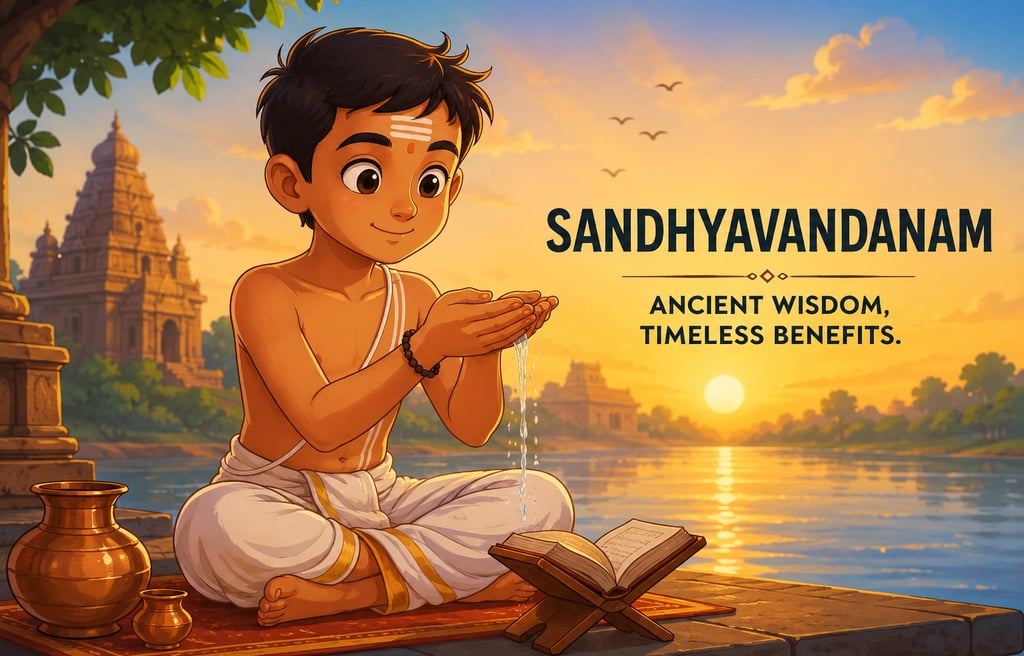
Sandhyavandanam:
The Original “Daily Reset Button” Our Ancestors Installed Before Smartphones
There are two kinds of mornings in Indian households.
One starts with: “Where’s my charger?”
The other starts with: “Did you do Sandhyavandanam?”
One charges your phone. The other, supposedly, charges you.
And honestly? Thus continues one of Hinduism’s oldest surviving daily rituals — Sandhyavandanam. Our ancestors may have been onto something. At first glance, it looks complicated. Water, mantras, hand positions, directions, spoon, darbha grass, confusion. But underneath all this is something surprisingly intelligent: a daily system to reset the mind, body, breath, and ego.
So… What Exactly is Sandhyavandanam?
Sandhyavandanam is a daily Vedic ritual traditionally performed during the “sandhya” times — the junctions of the day:
Sunrise
Noon
Sunset
Think of it as spiritual maintenance. Not dramatic. Not flashy. No temple bells shaking the ceiling. Just water, breath, sunlight, mantra, silence, and attention.
The word itself breaks down beautifully:
Sandhya = transition period
Vandanam = salutation or reverence
So essentially, it means "Pausing to acknowledge the changing moments of life.” That already sounds more emotionally mature than most WhatsApp arguments.
Basically, ancient rishis looked at humans and said:
“Your brain becomes unstable every few hours. Please restart system.”
Modern people use:
Coffee breaks
Doomscrolling
Spotify playlists
“Bro I need a mental reset”
Ancient India used:
Pranayama + sunlight + mantra + mindfulness + water therapy. Honestly, not a bad trade.
The Core Logic Behind It
Modern life teaches us to rush through transitions.
Wake up → scroll phone.
Lunch break → scroll phone.
Before sleep → scroll phone.
Our ancestors instead inserted awareness into transitions. Sandhyavandanam is less about “pleasing God” and more about:
resetting the mind,
regulating the breath,
grounding attention,
and aligning yourself with natural rhythms.
In today’s language? It’s part meditation, part breathwork, part gratitude practice, part nervous-system reboot. Except your grandfather did it without calling himself a “biohacker.”
The Process of Sandhyavandanam
Different traditions follow slightly different versions, but the general flow looks like this:
1. Achamanam (Purification): Sipping water with mantras to purify speech, body, and mind.
A common mantra:
Om Achyutaya Namah
Om Anantaya Namah
Om Govindaya Namah
Simple idea: Before speaking to the divine, clean up internally first. Honestly, society would improve dramatically if people did this before commenting online too.
2. Pranayama (Breath Regulation): Controlled breathing with the Gayatri mantra. This slows the nervous system and sharpens concentration.
The famous mantra:
Om Bhuh, Om Bhuvah, Ohum Suvah, Om Mahah, Om Janah, Om Tapah,
Ohum Satyam, Om Tat-Savitur-Varenyam Bhargo Devasya Dhimahi
Dhiyo Yo Nah Prachodayat, Om Apo Jyoti Rasomrtam Brahma
Bhur-Bhuvah-Svar Om
Meaning:
The first lines (Om Bhuh, Om Bhuvah...) represent the physical and spiritual realms: Earth, atmosphere, heaven, and higher planes of truth and consciousness. The Gayatri Mantra: The middle section is a prayer that translates to: "We meditate upon the supreme, radiant light of the divine Sun. May that divine light illuminate our intellect and guide us on the path of righteousness." Closing: "Om, the divine essence is the light, the nectar of immortality, the ultimate reality encompassing all worlds.
Notice something interesting: The prayer is not asking for money, revenge, six-pack abs, or a luxury SUV. It asks for clarity of intellect. That’s civilization-level wisdom.
3. Arghyam (Offering Water to the Sun): Water is offered facing the sun.
Symbolically:
the ego is surrendered,
gratitude is expressed,
and awareness of cosmic dependence is cultivated.
Scientifically? Morning sunlight exposure helps regulate circadian rhythm, improves alertness, and supports hormonal balance. Your ancestors basically invented sunrise therapy with copper vessels.
4. Gayatri Japa: Repetition of the Gayatri mantra multiple times.
This is the meditative core - the heart of Sandhyavandanam. The repetition creates rhythm. Rhythm creates stillness. Stillness creates clarity.
It’s the spiritual equivalent of letting muddy water settle. The goal is not volume. Not speed. Not showing off pronunciation like Carnatic music auditions. It is concentration. The mantra acts like mental tuning. Like clearing 87 browser tabs inside your head.
5. The Famous “Abhivādaye”
Now comes the part every Brahmin child fears during family gatherings.
Someone asks:
“Abhivādaye theriyuma?”. Immediate panic. Suddenly the child forgets, gothram, parampara, lineage, his own existence.
What is Abhivādaye? It is a traditional Vedic introduction where one respectfully states Paramparai lineage, Rishi ancestry, Gothram, Vedic tradition, and his name.
Example structure:
“Abhivādaye
[Pravara rishis] pravaranvita
[Gotra] gotrah
[Apastamba/Ashvalayana etc.] sutrah
[Yajur/Rig/Sama] shakadhyayi
[Name] Sharma namaham asmi bhoh”
Translation:
“I respectfully introduce myself as belonging to this lineage of rishis and Vedic tradition.”
In modern terms? LinkedIn, but spiritual. Not: “Worked at startup for 3 years.”
Instead:
“My ancestors memorized entire Vedas without Google Drive.”
6. Upasthana (Closing Prayer): Concluding prayers to the divine forces.
Kayena vacha manasendriyairva Buddhyatmana va
prakrite swabhavath Karoomi yadyad sakalam parasmai.
Narayanayeti samarpayami
Meaning:
“Whatever mistakes I have committed through body, speech, mind, or senses — may they be forgiven.”
This reinforces humility and gratitude toward the sustaining forces of life. That humility is powerful. Because after all the chanting and rituals, Sandhyavandanam quietly says: “You are still human. Stay grounded.”
Why Was It Done Daily?
Because the human mind leaks. Focus leaks. Patience leaks. Discipline leaks.
Sandhyavandanam was designed like daily mental hygiene. You brush your teeth every day because yesterday’s brushing doesn’t last forever.
Same principle. The ritual quietly trains:
consistency,
posture,
breath control & regulation,
memory,
pronunciation,
discipline,
and mindfulness.
All before breakfast. Meanwhile, most of us struggle to locate our socks.
The Modern Interpretation
You don’t have to see it as blind ritual.
Viewed deeply, Sandhyavandanam is:
intentional pausing,
mindful breathing,
gratitude practice,
solar alignment,
mantra meditation,
and emotional recalibration.
It teaches something modern culture desperately forgot: Ancient neuroscience wrapped in sacred ritual. Not every productive activity needs a screen. And maybe that’s why these rituals survived for thousands of years. Because beneath the Sanskrit, beneath the water offerings, beneath the tradition— there is a timeless human need: to stop, to breathe, and to remember that life is bigger than deadlines and notifications.
Honestly, the real miracle isn’t that people still perform Sandhyavandanam.
The real miracle is that a practice this ancient still feels psychologically relevant in the age of Wi-Fi and burnout.
And maybe, somewhere in the background…One paati shouting:
“Don’t skip evening Sandhyavandanam just because there’s IPL!”