The Quiet Custodians of Hinduism: Brahmins
From early morning suprabhatam battles to paatis correcting Sanskrit pronunciation mid-sambar, this humorous yet heartfelt blog explores the role Brahmins played in preserving Hindu traditions, rituals, and sacred knowledge across generations. Through “Sacred Logic,” we decode the scientific, psychological, and cultural meaning behind chants, lamps, temple bells, fasting, and daily practices — revealing how ancient wisdom quietly survived inside ordinary homes, filter coffee conversations, and stubborn family routines. A funny, nostalgic, and thoughtful tribute to the people who helped keep Hindu culture alive.
The Last-Minute Defenders of Hinduism
Also known as: Brahmins who forgot where they kept their vibuthi but still somehow preserved a civilization.
Every Brahmin household has that one scene.
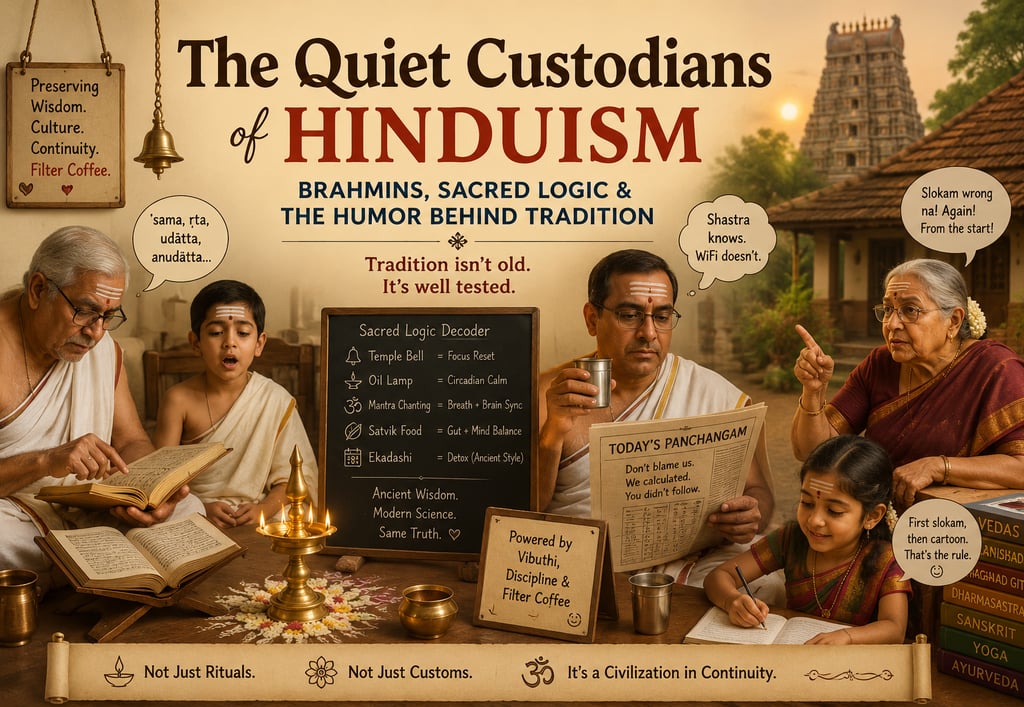
Someone is shouting: “Where is the panchangam?”
Another person is searching for matchbox near the lamp.
Paati is yelling that the slokam pronunciation is wrong.
Thatha is correcting everyone’s Sanskrit while simultaneously asking where his glasses are… when the glasses are already on his head.
And somehow, amidst all this beautiful chaos, Hindu culture quietly survives.
Not through giant empires.
Not through marketing campaigns.
Not through viral reels titled “Top 5 Spiritual Hacks.”
But through ordinary families doing small things consistently for generations. That is probably one of the most underrated roles Brahmins played in nurturing Hinduism — they preserved continuity. Hinduism Survived Because Somebody Remembered Everything.
Think about it. Hinduism is not a religion built around one central authority or one single book. It’s more like the world’s oldest open-source project.
Thousands of rituals.
Hundreds of philosophies.
Multiple languages.
Countless traditions.
And yet, for centuries, someone had to remember:
festival timings,
temple procedures,
mantras,
pronunciation,
astronomy calculations,
dietary systems,
philosophical teachings,
music,
rituals,
lineage traditions,
and exactly which vessel is only for making rasam during amavasya.
Highly critical cultural infrastructure. Brahmins became one of the communities entrusted with preserving these systems. Not because they were superheroes. Let’s be honest. Most Iyengar and Iyer uncles still panic if WiFi stops working for six minutes. But discipline? Repetition? Ritual consistency? That became deeply embedded into daily life.
Sacred Logic: Why These Traditions Actually Made Sense
The funny thing is — many rituals that modern people dismiss as “old customs” often have astonishing logic underneath them.
Take temple bells --- People think it’s just noise. But scientifically, layered metallic frequencies help interrupt mental chatter and pull attention into the present moment. It’s basically ancient mindfulness technology.
Lighting lamps during sunset? --- Human psychology changes during transition hours between day and night. A steady flame naturally calms visual focus and creates mental grounding.
Why chant mantras repeatedly? --- Controlled rhythmic chanting regulates breathing patterns and activates the parasympathetic nervous system — the body’s calming mode.
Ancient rishis may not have said: “Bro, this optimizes neural regulation.”
But they absolutely understood human experience deeply. Honestly, half of Hindu rituals are ancient neuroscience wearing vibuthi. The Original Cloud Storage: Paati Memory
One of the greatest scientific achievements in Indian civilization was oral preservation. Before hard disks, before servers, before PDFs named “Final_UseThisOne2.pdf”… there were Vedic chanting systems. Complex recitation methods like Ghana Patha acted almost like verbal error-correction coding. If one syllable changed, the pattern itself exposed the mistake. Entire scriptures survived for thousands of years through human memory alone.
Meanwhile today: “Machan, I forgot my password in 10 seconds.”
Respect the ancestors. Brahmin Homes Were Tiny Cultural Data Centers. People often imagine “preserving culture” as some dramatic cinematic activity.
In reality, it looked more like:
waking children up at unreasonable hours for festivals,
arguing about the correct way to tie veshti,
forcing reluctant kids to learn one slokam before watching cartoons,
debating whether sambar should contain onion & garlic,
and annual family wars over who forgot Ekadashi.
But hidden inside these routines was continuity.
Carnatic music survived this way.
Temple rituals survived this way.
Sanskrit chanting survived this way.
Philosophical traditions survived this way.
Civilizations are not preserved only in libraries. Sometimes they survive in stainless steel tiffin boxes and paati’s terrifying discipline.
The Modern Role of Brahmins
Today, the responsibility is changing. Young people no longer accept: “Just do it because elders said so.” Honestly, fair enough. The future of Hindu culture depends not on blindly repeating rituals, but on understanding and explaining them meaningfully. Because when the sacred logic is decoded scientifically, psychologically, and philosophically, traditions stop looking outdated.
They start looking brilliant. And maybe that is the real role now:
Not gatekeepers of tradition.
Not superiority complexes.
Not “our way only.”
But translators of wisdom.
People who can preserve wisdom while explaining why it matters in today’s world. Because culture survives when it remains emotionally alive — not mechanically followed. Keeping ancient knowledge alive — not through fear, superiority, or rigidity — but through clarity, humility, and understanding. And despite all the memes, chaos, overthinking, coffee addiction, and family debates… somewhere in a small Brahmin home...
...a lamp is still being lit at sunset.
... a slokam is still being taught.
... a festival is still being observed.
And quietly, one generation passes memory to the next.
That’s not small.
That’s civilization. And a civilization survives when its people remember not just what they do… but why.