Unveiling the Heart of Hindu Traditions
Dive into the rich tapestry of Hindu rituals, their ancient stories, and how these sacred practices resonate in today’s world with meaningful, scientific connections.
Shalini Iyer
4/14/20264 min read
Meaning, Purpose & Relevance in Modern Life
Hindu traditions are everywhere.
From the tiny lamp your grandmother insists on lighting every evening… to the mysterious “don’t touch this today, it’s auspicious” rules… to fasting days that somehow make snacks look more attractive than ever — traditions quietly shape daily life in ways we often don’t notice. And if you grew up in an Indian household, chances are you’ve asked at least one of these questions:
“Why are we doing this?”
“What happens if we don’t ring the bell?”
“Did someone just invent this ritual because they were bored 2,000 years ago?”
Fair questions.
For many people today, Hindu rituals can feel confusing, overly serious, or simply mechanical. Sometimes we follow traditions because our parents did. Sometimes because our grandparents gave us that look when we questioned it. But beneath the flowers, lamps, bells, mantras, and rituals lies something deeper — a fascinating system of meaning, awareness, discipline, symbolism, and yes… surprisingly practical wisdom.
That’s where Sacred Logic comes in. At Sacred Logic, we don’t just observe traditions. We decode them.
🧠 Beyond Rituals: There’s Actually a System Here
One of the biggest misconceptions about Hindu traditions is that they are random actions repeated for generations without reason. But when you slow down and really observe them, something interesting appears: most rituals are structured around intention.
Lighting a lamp is not just about “good vibes.”
Fasting is not simply religious dieting.
Chanting mantras is definitely not ancient karaoke.
Each ritual usually works on three levels:
What it symbolizes
What it does psychologically
Why it exists in the first place?
For example, lighting a lamp traditionally symbolizes moving from darkness to awareness. But practically, it also creates a pause. A reset. A small moment where the mind slows down before the chaos of the day resumes.
And honestly, in a world where most of us check our phones before our own thoughts in the morning, that pause matters... A lot...
🔍 The Difference Between Ritual & Routine
Here’s where things get interesting.
A ritual without awareness becomes routine.
You can mechanically light a lamp, ring a bell, chant something for five minutes… and mentally still be thinking about pending emails, exam marks, or whether you replied to that WhatsApp message. But the moment awareness enters the picture, the experience changes completely. The ritual stops being “something you have to do” and starts becoming something you actually experience.
That’s the difference between:
blindly following tradition
andconsciously engaging with it.
And no, this doesn’t mean you need to suddenly become deeply spiritual overnight and meditate in the Himalayas. It simply means asking: “Why does this exist?”. That one question changes everything.
🪔 Why Traditions Still Matter Today
Modern life is noisy. Our attention is constantly scattered between notifications, deadlines, scrolling, stress, and trying to remember why we walked into a room in the first place. In this kind of world, rituals become surprisingly valuable.
Not because they force religion into life — but because they introduce pause into life.
A lamp lit in the evening.
A few minutes of chanting.
A moment of silence before prayer.
These small acts create structure in an otherwise restless day. They act like anchors. And honestly, we all need anchors sometimes.
🔬 The “Scientific” Side Everyone Wants to Know About
Let’s be honest — at some point, almost every modern Indian kid has asked:
“But what’s the scientific reason?”
And while not every tradition can or should be reduced to science alone, many rituals do have practical dimensions.
Chanting regulates breathing.
Fasting builds restraint and discipline.
Repeated rituals create mental structure and habit.
Temple environments reduce sensory overload and encourage focus.
In many ways, traditions function like ancient behavioral design systems.
Just with more lamps and fewer TED Talks...
🌿 Adapting Traditions Without Losing Meaning
One important thing to understand is this:
Traditions were meant to survive — not fossilize.
You do not need a perfectly arranged puja room, 47 ritual items, and expert-level Sanskrit pronunciation to connect with meaning. You can simplify... You can adapt... You can ask questions.
And contrary to popular fear, no cosmic audit team is waiting to deduct points because you forgot one step during a ritual. What matters most is intention and awareness. A simple practice done consciously often carries more depth than an elaborate ritual done mechanically.
🎯 From Blind Following to Meaningful Living
The real transformation begins when tradition stops feeling like obligation and starts feeling like understanding.
Instead of:
“What should I do?”
You begin asking:
“Why are we doing this?”
That shift is powerful.
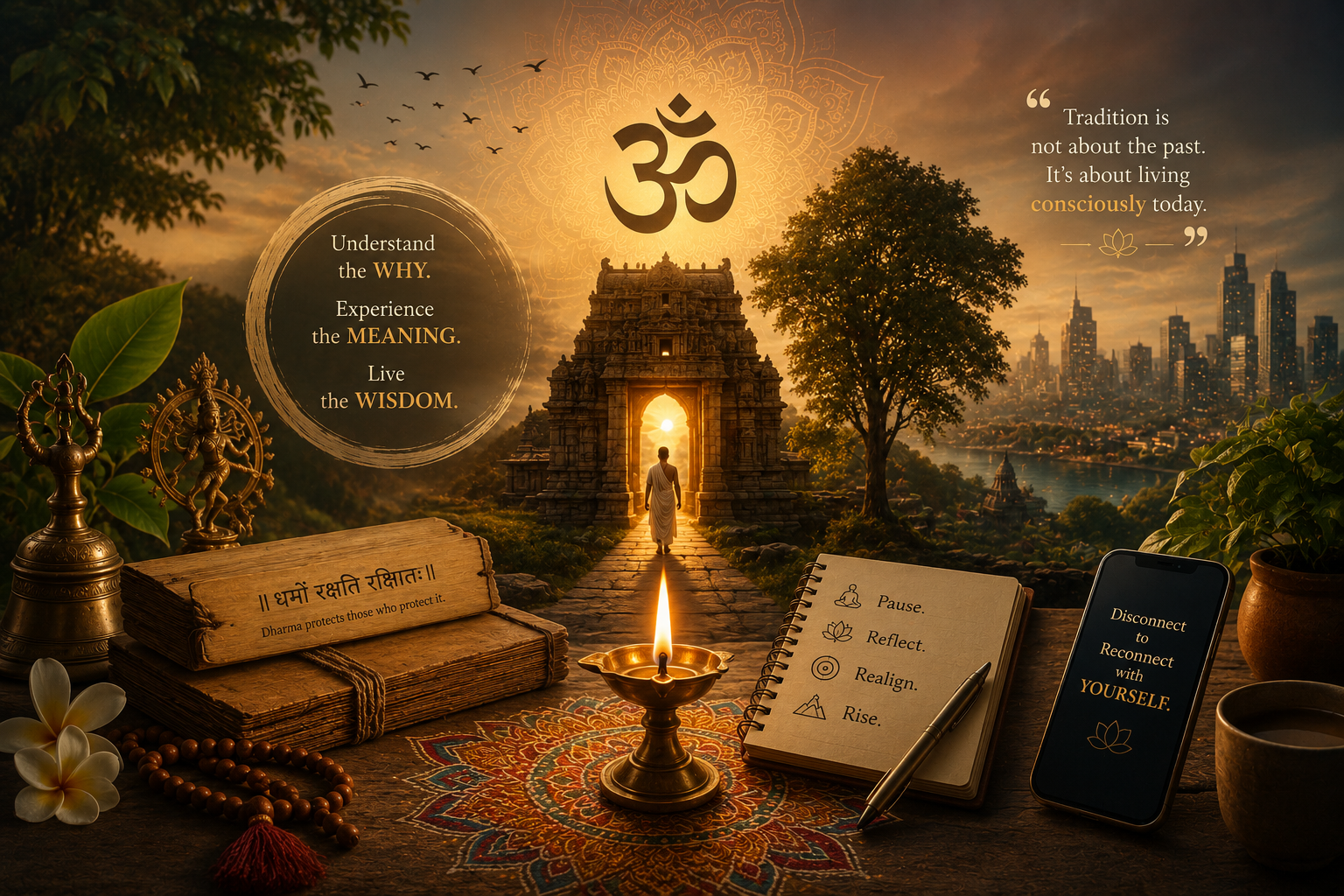
Because once you understand the why, rituals stop feeling forced.
They begin to feel Personal... Natural... Relevant.
🪔 The Sacred Logic Perspective
At Sacred Logic, we believe traditions deserve more than blind acceptance or instant dismissal.
They deserve understanding.
Some rituals may be symbolic.
Some practical.
Some deeply philosophical.
Some beautifully psychological.
But almost all of them become more meaningful when explored with curiosity instead of fear. Because tradition is not the opposite of modern thinking. When understood properly, tradition and logic can actually sit at the same table... Preferably with filter coffee.
My Final Thoughts.. Hindu traditions are not really about going backward into the past. They are about bringing awareness into the present. And maybe that’s the real heart of it all.
Not perfection.
Not blind obedience.
Not fear.
Just deeper understanding.
Don’t just follow tradition.
Understand it. Experience it. Live it.