Why Do We Fast? The Spiritual, Scientific & Surprisingly Funny Logic Behind Fasting
Why do humans fast across cultures and religions? This humorous and insightful blog explores the spiritual, scientific, and psychological logic behind fasting — from ancient Hindu traditions to modern intermittent fasting trends. Discover how fasting is more than skipping meals; it’s a practice of discipline, mindfulness, gratitude, and inner balance, explained with relatable humor and real-life examples..
SCIENCE BEHIND TRADITIONSDAILY RITUALS
Shalini Iyer
4/21/20263 min read
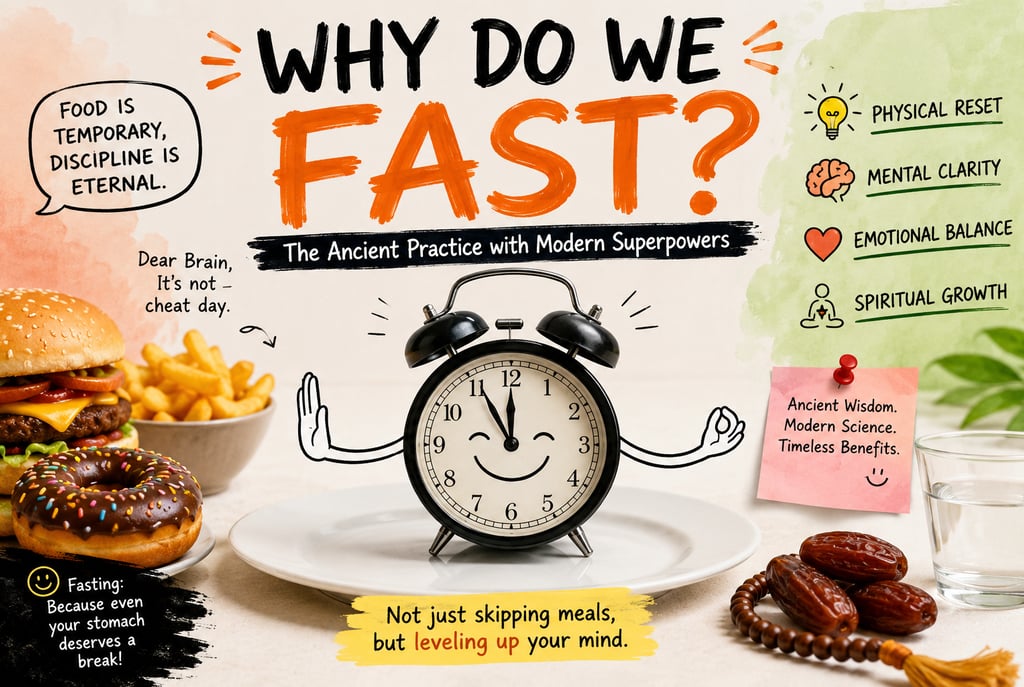
Fasting - Ancient Spiritual Practice… or Humanity’s Original “System Update”?
There are two kinds of people during fasting.
One person says: “I am transcending worldly desires.”
The other person opens the fridge every 11 minutes just to stare at leftover dosa like it’s a lost lover.
Fasting has existed in almost every culture and religion for thousands of years. In Hinduism, Islam, Christianity, Buddhism, Jainism — everyone somehow independently arrived at the same idea: “Maybe… eating non-stop is not always the answer.” Which is honestly shocking, because if Swiggy and biryani existed in ancient times, half these traditions may never have survived.
But jokes aside, fasting was never just about “God getting happy because you skipped lunch.” There’s actually a deep logic behind it — spiritually, mentally, socially, and even biologically.
First: What Is Fasting? Fasting simply means voluntarily avoiding food (or certain foods) for a period of time. In Hindu traditions, fasting can mean:
skipping grains,
eating only fruits,
eating once a day,
avoiding salt,
or surviving entirely on coffee and determination during Ekadashi.
Different methods, same core idea: discipline over impulse.
Because humans are creatures of habit. If the brain says: “Eat chips at midnight.”, most of us don’t say: “No.” We say: “Only a little.” Then suddenly the family-size packet becomes a personal spiritual journey.
Fasting trains the mind to pause before obeying every craving. That’s the real game.
The Ancient Logic Behind Fasting
People often assume ancient traditions were random. But old civilizations observed human behavior very carefully. They noticed something: When humans constantly consume — food, entertainment, noise, gossip — the mind becomes restless.
Fasting interrupts that cycle. It’s basically the ancient version of: “Bro… calm down for a second.” In Hindu traditions, fasting days were often aligned with lunar cycles, temple rituals, or specific seasons.
Why? Because ancient communities understood rhythm.
Some fasting periods came after heavy festival eating.
Some happened during seasonal transitions.
Some encouraged simpler diets during hotter months.
This wasn’t accidental. Your grandmother may not say: “I am optimizing metabolic flexibility and digestive efficiency.” She’ll simply say: “Today no rice. Eat fruits.”
Same concept. Less TED Talk energy.
The Modern Scientific Interpretation
Now modern science is entering the chat like: “Actually… the ancients may have been onto something.” Research around intermittent fasting suggests benefits like:
digestive rest,
better insulin response,
improved focus,
mindful eating habits,
and reduced overeating.
When digestion constantly works overtime, the body rarely gets a break. Fasting gives the system temporary rest — like restarting a phone that has 47 apps open and is somehow still playing music from somewhere. Also, fasting changes your relationship with food. You stop eating automatically.
You become aware of:
hunger,
boredom eating,
emotional eating,
stress-snacking,
and the mysterious human instinct to open the fridge immediately after eating a full meal.
The Spiritual Side Most People Miss: The deeper purpose of fasting was never punishment. It was awareness. Think about it: If you cannot control one simple craving for a few hours… how will you control anger, ego, jealousy, distraction, or laziness?
Fasting is mental training disguised as food restriction. That’s why many traditions combine fasting with:
prayer,
silence,
charity,
meditation,
or self-reflection.
The goal wasn’t: “Be hungry and suffer.”
The goal was: “Realize how attached you are to comfort.” - Big difference.
So… Does Fasting Still Matter Today?
Honestly? Maybe more than ever. Modern life is built on constant consumption:
scrolling, snacking, watching, buying, clicking, ordering.
Fasting becomes a rare moment where you intentionally say:
“I don’t need to satisfy every urge immediately.”
That’s powerful.
Even today, fasting can become:
a reset button,
a discipline practice,
a mindfulness exercise,
or simply a way to reconnect with tradition and gratitude.
Because after a fast, even plain curd rice tastes like a Michelin-star meal. And maybe that’s the hidden wisdom. Fasting teaches you something modern life keeps trying to erase:
Enough is possible.